

TLDR: The Federal Court has clarified when parties can file new evidence on appeal from TMOB decisions under the amended Trademarks Act. Leave will depend on factors such as relevance, materiality, delay, and prejudice. The Court departed from the stricter Palmer test, noting that statutory appeals from administrative tribunals are more flexible, though whether evidence could have been before the TMOB remains important. Applicants should no longer assume that new evidence is automatically permitted on appeal.
When can an appellant file new evidence to the Federal Court on appeal of a Trademark Opposition Board (TMOB) decision?
Before April 1, 2025, when certain amendments to the Trademarks Act came into force, new evidence was virtually always permitted (often resulting in a de novo hearing on a new evidentiary record).
Under the new amendments after April 1, 2025, s. 56(5) of the Trademarks Act required leave of the Court before additional evidence could be filed. However, the Act did not set out the circumstances upon which the Court could exercise its discretion to grant leave.
New Test for New Evidence on Appeal of TMOB Decisions
In Products Unlimited, Inc v Five Seasons Comfort Limited, 2026 FC 48, issued on January 14, 2026 by Justice McHaffie, the Federal Court provided a new test to determine when applicants (appellants) can adduce new evidence under s. 56(5). The Court will now consider whether the interests of justice favour granting leave on the basis of “all relevant factors” including:
- the relevance, credibility, and admissibility of the evidence;
- the materiality of the evidence;
- the circumstances surrounding the delay in filing the evidence; and
- whether granting leave would cause prejudice to the opposing party.
This test was partly derived from the Palmer test,1[1980] 1 SCR 759 an existing procedural test generally governing the filing of new evidence on appeal of a court decision. Under the Palmer test and related case law, appellants were effectively prohibited from filing new evidence on appeal if the evidence was available earlier (at trial) by the exercise of due diligence.
However, the Federal Court found that this test was not directly applicable to statutory appeals (such as appeals from trademark opposition proceedings) because these were more akin to applications for judicial review and should be somewhat more flexible. Further, the existence of a specific provision in s. 56(5) signalled a legislative intent to permit new evidence more broadly than in a typical appeal.
Nonetheless, the Court noted that “the question of whether the evidence could have been put before the Board remains an important one, and in some cases may be a determinative factor. However, other surrounding circumstances that may explain, for example, why evidence was not filed with the Board, may also be relevant. Such circumstances will necessarily be fact-specific and cannot be exhaustively enumerated.”
Conversely, the Federal Court also noted that the newly amended s. 56(5) should be interpreted to be stricter than pre-existing trademarks practice, in which new evidence was almost always allowed, because the legislation now specifically required leave of the Court.
This is consistent with the intent of the last round of amendments to the Trademarks Act and Regulations, in which the trademarks opposition board was granted more powers to address filing of evidence (e.g. issuing of confidentiality orders) and the encouragement to parties of putting their “best foot forward” in opposition proceedings.
The Court took care to observe, however, that there were (as on the facts of this case) many opposition proceedings commenced before the amended s. 56(5) came into force, during which parties could assume that new evidence was permissible on appeal, and that this was a relevant factor in granting discretionary leave.
It is expected based on recent timelines and practice before the trademarks opposition board that many other such appeals will fall within this circumstance.
On the facts of the case, the Court was persuaded that leave should be granted to the appellant (applicant) to file its new evidence. In particular, the Court focused on the fact that the new evidence was material and was adduced by the applicant to rebut reply affidavit evidence filed by the opponent during the TMOB proceedings at, or after, written submissions were filed, which did not leave the applicant with any ability to respond.
Standard of Review
Relatedly, the Court also held that the existing approach to standard of review (pre-amendment) continued to apply with minor modifications, yielding the following test:
- Questions of law, including those that are extricable from questions of mixed fact and law, are subject to the correctness standard.
- Where no additional evidence has been adduced, either because none was tendered or because leave was not granted, the standard of palpable and overriding error will apply to questions of fact and questions of mixed fact and law.
- Where leave has been granted to adduce additional evidence, the Court will presumably have determined at the leave stage that the new evidence is material. If so, the Court will conduct a de novo review and apply the correctness standard with respect to that additional evidence, and the palpable and overriding error standard in respect of findings unaffected by the additional evidence.
Functionality Doctrine
The merits of the case were also interesting, involving the doctrine of “functionality”. The trademark at issue was a visual design sought to be registered in association with “Air filters for industrial and commercial uses and installations namely filters for paint booths”.
As seen below, the trademark application incorporated certain diamond shaped visual features (left), which can be seen on a sample of the applicant’s product (right).
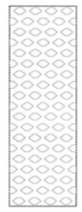
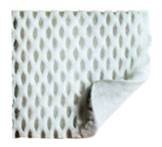
The TMOB had held at first instance that the design was unregistrable under s. 12(2) of the Trademarks Act because the applicant’s product had diamond-shaped features which were functional, such as providing advantages relating to holding overspray, doubling surface area, and providing superior wet tensile strength.
The new evidence allowed by the Federal Court established that the functional advantages referred by TMOB were actually due to unique three-dimensional filter designs rather than of the two-dimensional visual design itself.
The Court also noted that, in respect of the legal test under s. 12(2), the mere existence of some functional features does not exclude a trademark from protection. Rather (reiterating the language of the statute), only features “dictated primarily by a utilitarian function” are prohibited. Thus, “subsection 12(2) indicates that (a) the features of a trademark may have a secondary or peripheral utilitarian function without making it unregistrable; and (b) the features need not be solely functional in order to make the trademark unregistrable”.
In the result, the Court allowed the appeal and the trademark was allowed to be registered.
Key Takeaways
- Under the post-April 1, 2025 Trademarks Act, new evidence on appeals of TMOB decisions will be subject to a more limited discretionary test and should not be taken for granted.
- However, appellants (applicants) who are/were involved in TMOB proceedings decided (or had the evidentiary phase commenced) before April 1, 2025 may be able to continue filing new evidence on appeal to the Federal Court on the basis that the evidentiary obligations were lower.
- Parties involved in new TMOB proceedings should assume that they are required to “put their best foot forward” and are well advised to file as much material evidence as possible during opposition proceedings at first instance rather than exposing themselves to risk that new evidence will not be granted on appeal.
If you have any questions, please contact the author or our trademarks team at trademarks@anandsiu.com.