


TLDR: In Proslide Technology v Whitewater West Industries Ltd, 2026 FCA 59, the Federal Court of Appeal overturned a trial court finding that a patent was invalid for overbreadth. In its reasons, the FCA appeared to limit the extent of extrinsic evidence (i.e. inventor and expert testimony) relevant to the overbreadth inquiry. Instead, the FCA focused on the invention made or contemplated as disclosed in the patent specification.
Water Slides and Amusement Rides
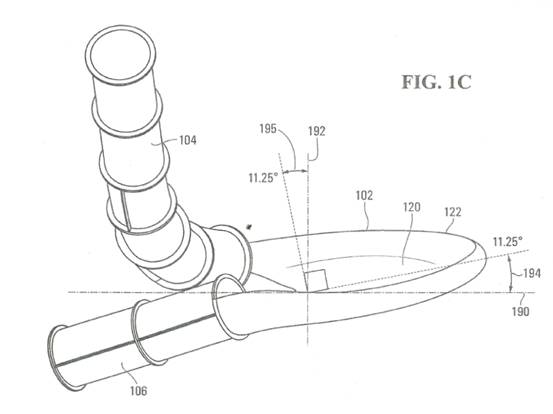
The patent at issue was one among a family of patents owned by ProSlide relating to various technologies and configurations of water slides. The patents claimed numerous features including those relating to roll and pitch angles, as well as the shapes of the slide walls and surfaces. Additionally, the claims were not limited to water slides but also related to amusement rides (unlike other patents in the family that were limited to water slides).
One exemplary figure of the slide configurations is shown below:
A Controversial Trial Decision on Overbreadth
In the original trial decision, reported at 2024 FC 1439, Justice Manson of the Federal Court had held that the patent at issue (one of several asserted by Proslide in the trial) was invalid for being broader than the invention made or contemplated by the inventor.
This was a notable—and controversial—decision when it was issued, for at least three reasons.
First, the asserted claims of the patent were held only invalid for overbreadth, without any findings of obviousness, insufficiency, or Inutility. Almost all prior cases of overbreadth had included other invalidity findings, most commonly insufficiency and overbreadth, based on the same facts. Overbreadth was therefore often obiter dicta and it was not certain how much weight this basis of invalidity carried as an independent ground.
Second, the Court found that the claims were broader than the invention made without finding that the claims were broader than the invention disclosed. This has rarely (if ever) occurred in Canadian patent law. It was unclear before the trial decision whether the two branches of overbreadth were truly distinct, and how they differed, since they were almost always quoted together and dealt with on the basis of the patent specification.
Third, the Court relied heavily on subjective inventor evidence as well as expert evidence opining on inventor notes and reports in coming to his conclusion, rather than the patent specification. This finding led to vigorous discussion among the patent bar. Some practitioners were concerned that the scope of inventor testimony (and discovery) had been widened to include a higher degree of subjectivity, since the Court felt it important to analyze what the inventor had contemplated in his notes, reports, and models.
Appeal Court Refocuses Overbreadth on Patent Specification
On appeal, Justice Locke, writing for the unanimous FCA, granted Proslide’s appeal, overturning the trial judge’s finding of overbreadth. The decision included several important comments that are likely to be influential in overbreadth cases going forward.
Justice Locke (citing his previous decisions in Seedlings, 2021 FCA 154 and Western Oilfield, 2021 FCA 24) confirmed that overbreadth remains a valid and independent ground of invalidity. More specifically, (despite agreeing with them on the merits) he rejected ProSlide’s argument that the “claims broader than invention made” was not a proper ground of invalidity.
Instead, the FCA felt that there was “consistent jurisprudence” and that the prior decisions could not be overruled because they were not “manifestly wrong”. The line of cases cited by the FCA therefore establish that there are two branches of overbreadth. A patent is invalid if it claims more than it discloses or more than the inventor as made.
On the application of the test, the FCA acknowledged that it may be in practice difficult to distinguish between claims broader than invention made and claims broader than invention disclosed:
[34] … I acknowledge that it is not entirely clear how a claimed invention could be broader than the invention made without also being broader than the invention disclosed, but this is not a basis to override consistent jurisprudence.
The FCA also implicitly adopted the trial judge’s formulation of the test, in that claims are invalid if they are broader than the invention made or contemplated by the inventor.
However, despite finding that the trial judge was correct at law in recognizing the two separate branches of overbreadth, the FCA found that the trial judge erred by relying on the testimony of the inventor as to what he contemplated during development before filing the patent, and expert testimony opining on the inventor’s development work, without regard to the invention as described in the patent.
Instead, the FCA ruled that the patent specification is the best source of evidence for what the inventor made or contemplated at the filing date of the patent:
[36] Despite my acknowledgement that claiming more broadly than the invention made is a distinct ground of invalidity from claiming more broadly than the invention disclosed, it does not follow that the invention made (or contemplated) should be determined without reference to the patent specification. On the contrary, in most cases, it is difficult to imagine a more reliable (and more timely) indication of what the inventor contemplated than the patent specification. The relevant date for assessing the issue of overclaiming is the filing date of the patent application, and that patent application is an explicit and carefully written statement on that date of what the inventor had in mind. […]
On the facts of the case, the patent specification used optional language (such as “other embodiments”, “may be formed with…”, “may provide”, “may have”, and “may be”) to describe the key elements that were initially held to be essential but omitted from the claims.
The FCA noted that this was evidence that the inventor contemplated the elements as not essential and should not have been ignored in favour of evidence as to what the inventor had in mind before filing of the patent application. The FCA did not refer to the inventor evidence as part of its finding.
It appears the FCA ruled the main error of the trial judge was to prefer inventor testimony over the patent specification where they conflicted, even if “broader than invention made or contemplated” is a separate branch of invalidity.
In the result, the trial judgement was overturned on this ground and Proslide’s patent was held to be valid (the utility of the patent was also at issue but was upheld by the FCA).
Impact of the Case
The FCA decision will undoubtedly be cited as binding authority on future overbreadth cases. The main takeaways from this case are:
- Overbreadth remains an independent ground of invalidity at law.
- Claims broader than invention made/contemplated is a separate branch of invalidity than claims broader than invention disclosed.
- The patent specification is the best evidence of what the inventor contemplated at the date of filing, and should be preferred over inventor testimony.
The latter two propositions may be in conflict with each other, as the Court did not clearly delineate the difference between the two branches of overbreadth. It appears that, under the now-present state of law, the ground of overbreadth will be focused heavily (if not exclusively) on the patent specification.